Identification of Bacteria Associated with Antimicrobial Sponges on Nangka Besar Island, Central Bangka
DOI:
https://doi.org/10.33019/ekotonia.v10i2.2456Keywords:
Antimikroba, Bakteri, Spons, Pseudomonas sp. Escherichia coli, Staphylococcus aereusAbstract
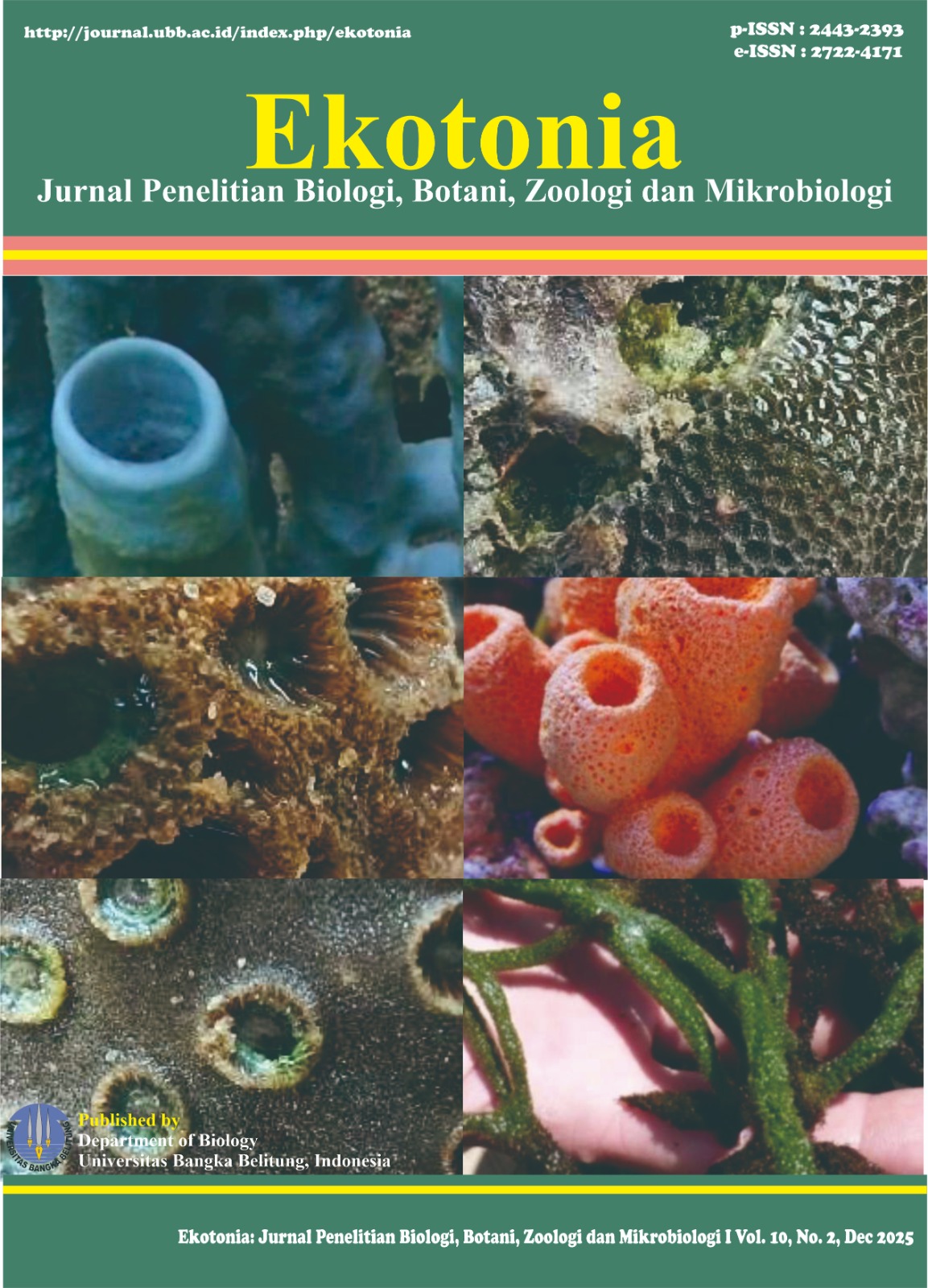
Sponges are benthic biota that are found in all marine and freshwater ecosystems. This animal has many pores and channels in all parts of its body. Marine organisms such as sponges often live in association with marine fungi that can produce antimicrobial compounds. This study aims to determine the types of sponges and the types of bacteria found in the waters of Nangka Island, Central Bangka Regency. The samples obtained were then incubated for further purification of the bacterial isolates. The results of this study indicate that there are 4 types of sponges, namely Haliclona mediterranea, Gelliodes fibulata, Cribrochalina sp, and Spongilla lacustris. Identification of the bacteria itself can be done by means of an antibacterial test using a disc test by 3 kinds of bacteria, namely Pseudomonas sp. Escherichia coli, Staphylococcus aereus and the results of antibacterial tests using extracts from 4 species against 3 types of test bacteria showed that only one type of bacteria had a response to the test material.
Keywords: Antimicrobial, Bacteria, Sponge, Pseudomonas sp. Escherichia coli, Staphylococcus aureus
References
Baker, K. F. & R.J. Cook. (1974). Biological
Control of Microbial Plant Pathogen. San
Fransisco: Freeman WH.
Polewali dan Pulau Sarappolompo
sebagai Penghasil Antibakteri Terhadap
Bakteri Patogen pada Manusia dan Ikan.
[Skripsi]. Jurusan Ilmu Kelautan.
Universitas Hasanudin: Makasar.
Ritchie, K. (2006). Regulation of microbial
populations by coral surface mucus and
mucusassociated bacteria. Marine
Ecology, 322: 1–14.
Schlegel, H.G. & K. Schmidt. (1994).
Mikrobiologi Umum Edisi Keenam.
Yogyakarta: Gadjah Mada University
Press.
Suryati, N., Bahar, E., & Ilmiawati. (2017). Uji
efektivitas antibakteri ekstrak Aloe Vera
terhadap pertumbuhan Eschericia coli
secara in vitro. Jurnal Kesehatan Andalas,
6(3): 518- 522
Tanjung, M.J.P., Yoswaty, D., & Effendi, I.
(2020). Aktivitas antibakteri ekstrak
karang lunak Lobophytum sp. terhadap
bakteri patogen (Escherichia coli,
Staphylococcus aureus, dan
Pseudomonas aeruginosa). Jurnal
Perikanan dan Kelautan, 25(2):151
Taylor, M.W., Radax, R., Steger, D., &
Wagner, M. (2007). Sponge-associated
Microorganisms: Evolution, Ecology, and
Biotechnological Potential. Microbiology
and Molecular Biology Reviews, 71(2):
295-347.
Thakur, N.L. & Müller, W.E.G. (2004).
Biotechnological potential of marine
sponges. Current Science, 86(11): 1506-
1512.
Hamidah, N.M., Rianingsih, L., & Romadhon.
(2019). Aktivitas antibakteri isolat
bakteri asam laktat dari peda dengan
jenis ikan berbeda terhadap E. coli dan
S. aureus. Jurnal Ilmu dan Teknologi
Perikanan, 1(2): 11-21
Pastra, D, A. Melki & Surbakti, A. (2012).
Penapisan bakteri yang bersimbiosis
dengan spons jenis Aplysina sp sebagai
penghasil antibakteri dari perairan pulau
tegal lampung. Jurnal Maspari, 4 (1):
77-82.
Putra SA. (2020). Kaji cepat ungkap kondisi
sehat komunitas spons karang pada
terumbu karang Kepulauan Krakatau.
Jurnal Ilmu-Ilmu Hayati, 19(1): 109-123.
Rastina, Sudarwanto, & M., Wientarsih, I.
(2015). Aktivitas antibakteri ekstrak
etanol daun Kari sp. (Murraya koenigii)
terhadap Escherichia coli, Staphylococcus
aureus, dan Pseudomonas. Jurnal
Kedokteran Hewan, 9(2): 185-188
Radji, M. (2011). Mikrobiologi. Buku
Kedokteran. ECG: Jakarta
Rizka, A.F.M. (2013). Skrining Bakteri
Simbion Spons Asal Perairan Pulau
Downloads
Published
Issue
Section
License
Copyright (c) 2025 Siti Ade Nur Milah

This work is licensed under a Creative Commons Attribution 4.0 International License.